Remembering Doug Walker
Doug Walker was one of those guys I always thought was invincible in the mountains, a view that anyone who saw him scramble up a mountain likely shared--sadly his death is a reminder that none of us are.
I remember when I first met Doug over 15 years ago (I doubt many can forget their first time meeting Doug) at a fundraiser for a conservation group where he was being honored for his contributions. As the event staff tried to clean up the room and the crescendo of stacking chairs increased (in a vain attempt to give us all the message it was time to go home) Doug was peppering us all with an endless stream of geography trivia.
I'll admit that the geography quiz (or Civil War quiz) was not something I ever engaged in and seeing me roll my eyes when he started in with me at an event at his house one evening he quickly sensed my lack of interest. We instead got into a discussion of art history and discovered we both had an interest in the painters of the Hudson River school. I told him about a lecture I had been working to develop on the subject of the importance of the western landscape painters for educating members of Congress in the effort to designate Yellowstone National Park (beginning with Thomas Moran's participation in the Hayden Expedition) and the evolution of our advocacy for public lands from landscape paintings to Instagram. Doug was intrigued and soon we had left the party he was hosting behind and disappeared for the next 20 minutes talking about art as he showed me some of his personal collection in rooms throughout the house. As the finale on the tour he took me to a room where he casually showed me a painting from one of the more well-known 19th century landscape artists--an individual whose artwork we had been discussing earlier in the evening. The experience was a remarkable example of the breadth of Doug's knowledge and intellectual curiosity: "you don't like my Civil war trivia?; OK, I'll meet you at your interest in art history." Not only had he met the challenge of letting me choose the subject of 19th century art history; he had a painting in his house of one of the very artists I had brought up in the discussion!
Doug and I crossed paths on a regular basis; we served together on the board of Forterra, the Advisory Council of The Mountaineers, and he was a board member of Outdoor Alliance where I serve as one of the policy chiefs. I would get the occasional phone call from him that usually started with, "what do you think about..." He always had his own thoughts on the matter but challenged me to go first. Through all those conversations however he was genuinely interested in my perspective. As the dialogue ensued he would challenge my own thinking and approach. Having a conversation with Doug could be intellectually exhausting but I always benefited from the exchange. Doug had that impact on people: he could make you a better climber or a better critical thinker as he challenged you to reach your full potential and then exceed it.
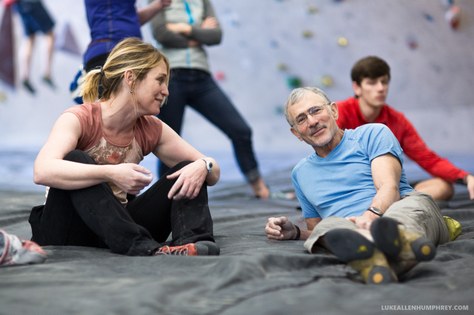 |
| Doug was not one for the coffee shop meeting; if you had something to discuss you met at the climbing gym or on a trail in the North Cascades. Photo credit: Luke Humphrey, via The Mountaineers. |
Doug recognized talent and passion in individuals and while he was mentoring me to become successful in river conservation, and think beyond the nose of my kayak, he was also mentoring countless other individuals--Martinique Grigg as she took the helm of The Mountaineers and worked to make it more relevant to families and a younger generation, Ben Greuel as he sought to bring new leadership to The Wilderness Society's work in the Cascades through initiatives that recognize the importance of both conservation and enjoyment of our public lands, Joe Sambataro as he developed a program with the Access Fund to bring the tactics of a land trust into the toolbox for the climbing community, Eddie Espinosa as he worked to implement the vision of the American Alpine Club to become more relevant to climbers through regional programs and services, Martin LeBlanc and his work to make the the dream of no child left inside a reality, Adam Cramer as he sought to build a new and effective coalition for outdoor recreation known as the Outdoor Alliance, and the list continues.
Many of us Doug mentored are in mid-career; we've been at it for a few years but still have potential to do some great things. Doug was quick to recognize that potential and willing to invest his time, money, and intellect to help us realize it. By any measure Doug was a successful individual--as a businessman, an outdoor athlete, a community civic leader, and an advocate for conservation and recreation--and he had a passion for helping others reach their potential to be successful. Sadly there will be no more of those engaging conversations, but I will remain forever grateful for the time he spent with me as a mentor and a friend. I know there are many of us who feel the same and his impact on our careers will live on.
Doug left us all a lifetime of work (and perhaps a little more). Now it's up to us to go out and execute. I'm sure he would remind us to remember to have fun--even if it's a little type II fun--and enjoy ourselves along the way.
Words from others:
- Seattle Times: Remembering a tech, environmental and philanthropic role model: Doug Walker
- The Mountaineers: Doug Walker 1950-1965
- Outdoor Alliance: Reflecting on Doug Walker's Life
- Forterra: Remembering Doug Walker
- UW College of the Environment: A Reflection on a Life Well Live--Doug Walker
- Rock and Ice: A Tribute: Doug Walker, First AAC President Killed in Office
- REI: Remembering Doug Walker, An Outdoor Industry Leader
- Alpinist: Remembering American Alpine Club President Doug Walker
- Trail Posse: The Doug Walker I Knew
- Outside: Doug Walker's Fierce Love of the Outdoors
- Geekwire: Seattle Software Pioneer Doug Walker Dies in New Year's Eve Hiking Accident on Granite Mountain
- Seattle Times: Doug Walker, Noted Conservationist and Philanthropist, Dies in Hiking Accident
- Washington Trails Association: In Memory of Doug Walker, Longtime Champion for Trails
- The Wilderness Society: Remembering Our Friend Doug Walker and His Great Conservation Legacy
Labels: conservation, Kids in the Outdoors, washington, wilderness
posted by Thomas O'Keefe @ 8:53 AM